Divided Again: What the 2026 Midterm Results Mean for Portfolios
Democrats won control of both the House and the Senate on 3 November, flipping seven Senate seats, several in states they had not won in years. Overnight, Nasdaq futures fell more than 2% at their low, Treasuries rallied and the dollar weakened. What the result changes for the next two years, what it does not, and why the AI trade took the first hit.
Photo: Black Flower Capital, data: NBC News
By Fabian Fach, Founder, Black Flower Capital
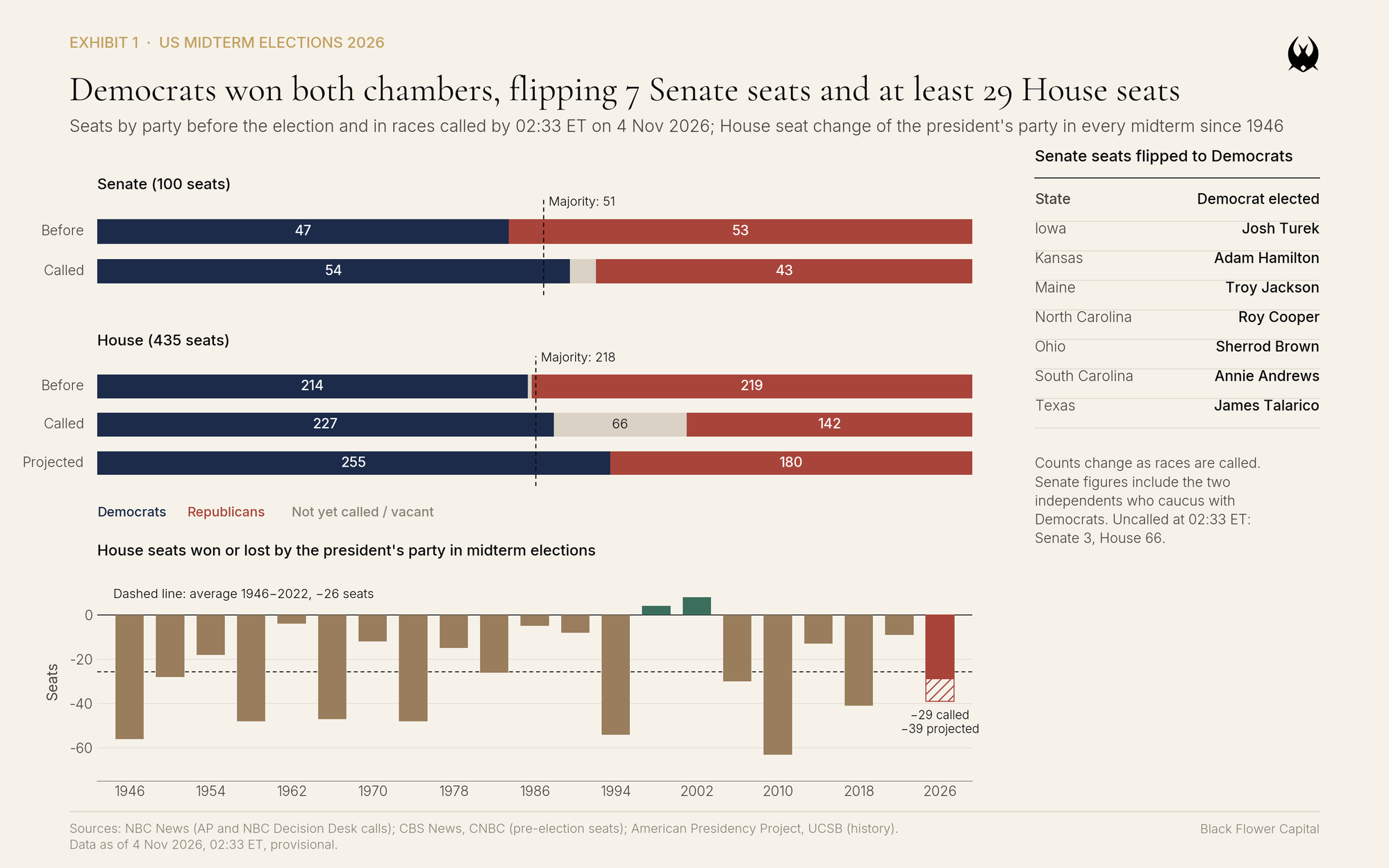
The 2026 midterm results are in: Democrats won control of both chambers of Congress in the elections on 3 November. In the Senate they flipped seven Republican seats: Iowa, Kansas, Maine, North Carolina, Ohio, South Carolina and Texas. In the House, where Republicans had held 219 seats to 214 before the vote, the networks projected a Democratic majority before midnight Eastern time. How large it will be is still open. Projections early on 4 November ranged from at least 235 seats (CNBC) to about 255 (NBC News), with dozens of races not yet called.
For the remaining two years of President Trump's term, the United States returns to divided government: a Republican White House and a Congress controlled by the other party from January 2027.
Who Won the 2026 Midterms: A Large Swing by Historical Standards
Midterms usually go against the president's party. Since 1946 it has lost an average of 26 House seats, according to the record compiled by the American Presidency Project at UC Santa Barbara, and it gained seats only twice, in 1998 and 2002.
This year's swing is at the upper end of that range. By early Wednesday morning, Democrats had already flipped 29 House seats on a net basis in the races called so far, and NBC News projected a final count that would mean a Republican loss of about 39 seats. Only a handful of post-war midterms were worse for the president's party: 1946, 1958, 1966, 1974, 1994, 2010 and 2018.
The Senate result stands out more. Several of the flipped seats were in states Democrats had not won in years. Roy Cooper's win gives Democrats their first Senate victory in North Carolina since 2008. In Maine, Troy Jackson unseated Susan Collins, who conceded before the Associated Press called the race. In Texas, James Talarico defeated Ken Paxton. Three Senate races, in Alaska, Mississippi and Nebraska, were still uncalled at the time of writing.
How Stocks, Bonds and the Dollar Reacted to the Midterm Results
Markets had moved toward this outcome during the day as prediction markets raised the odds of a Democratic sweep. The reaction came once the results were clear:
- Equity futures. Nasdaq futures fell more than 2% at their low overnight, according to Reuters, before recovering part of the loss. Chip and AI names led the decline.
- Treasuries. The 10-year Treasury yield fell about 6 basis points to around 4.90%, according to both Reuters and FXStreet.
- Dollar. The dollar index slipped to about 101.3, roughly 0.4 to 0.5% lower on the day.
Analysts gave two explanations. The first is fiscal. "Further tax cuts are put on ice and government spending" slows, as Prashant Newnaha of TD Securities put it to Reuters, which is good for bonds and less supportive for the dollar. Carol Kong of Commonwealth Bank of Australia made the same point about the currency: a Democratic sweep would limit government spending over the rest of Trump's term.
The second explanation concerns AI specifically. Newnaha cited "tighter regulatory scrutiny of technology and AI companies" as a risk of a Democratic Congress. Kim Seok-hwan of Mirae Asset Securities pointed to data centers: if Texas declares a moratorium on data centers, as New York did, projects could face further delays.
What Divided Government Means for Investors
Divided government mostly changes what can pass, not what is already in place. The practical consequences for the next two years are narrower than the overnight headlines suggest.
Fiscal policy becomes harder to move. Large new tax cuts or spending programmes now need agreement between a Republican president and a Democratic Congress. The market read that as less fiscal stimulus and lower long-term borrowing needs, which is why bonds rallied. Deadlines that require Congress to act, such as funding the government, become points of negotiation again.
Oversight increases. Control of committees gives Democrats subpoena power and the ability to set the agenda for hearings. For industries already under political scrutiny, that means more questions in public. AI, data centers and their effect on electricity prices are an obvious candidate. We wrote about the local politics of data center consent and household power bills in The Price of Consent. That issue now has a national stage.
Executive and monetary policy are unaffected in the short run. Trade policy, regulation through federal agencies and the Federal Reserve's decisions do not depend on who holds Congress. The Fed will continue to react to inflation and employment, not to the election result.
Why AI Stocks Took the First Hit
The overnight move followed a familiar pattern. The most concentrated part of the market reacted first and most. The largest 10% of US stocks now account for about 78% of the market's value, the highest share in data going back to 1926, as we showed in The Index That's Lying by Omission. Much of that weight sits in the companies building and supplying AI infrastructure. So does much of the new corporate debt, as covered in Borrowed Compute.
When a political event raises the regulatory risk for one theme, an index portfolio is more exposed to it than its broad label suggests. On the night, Treasuries did what a diversifier is meant to do: they rallied while equity futures fell. That has not been reliable in recent years. For most of 2026 stocks and Treasuries have moved in the same direction, as we showed in Correlation Instability. One night does not change that pattern.
What to Watch
The final seat counts will take days, and some House races may take weeks. Three things matter more for portfolios than the final margin:
- The first fiscal deadline under the new Congress, and whether it is handled as negotiation or confrontation.
- The agenda of the new committee chairs, in particular on AI, data centers and energy prices.
- Whether the rally in Treasuries holds once the focus moves from the election back to inflation and Federal Reserve policy.
This is not a forecast for markets, and it is not a political assessment. It is a description of what changed on 3 November and where the effects are most likely to show up. Seat counts in this article are provisional and reflect races called by the morning of 4 November.